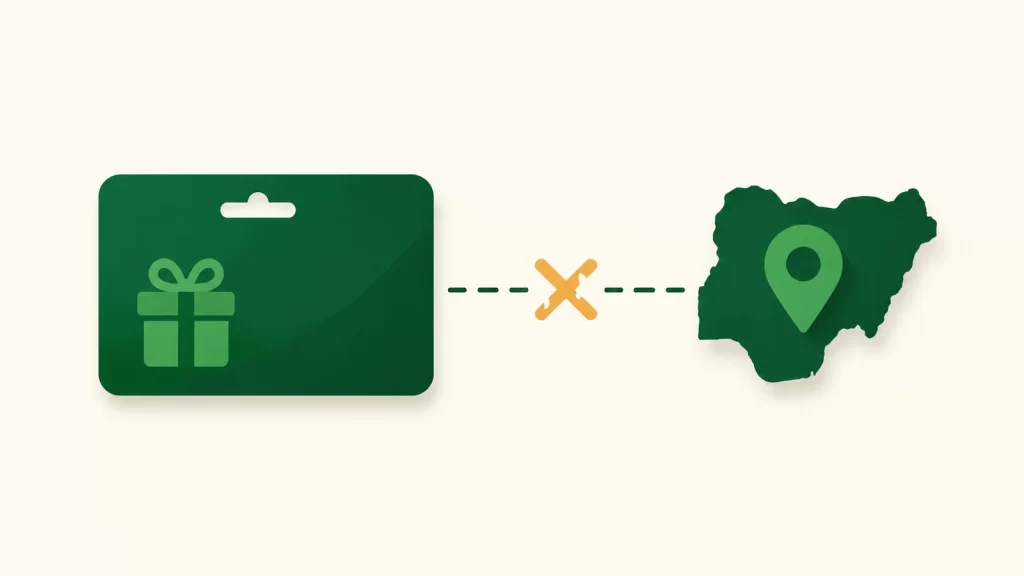
If Google Play says your gift card can only be used in another country, the key problem is usually a market mismatch—not a bad phone or a code that needs more retries. Google’s gift-card rules say a Play gift card must be redeemed and used in the country and currency where it was purchased, and the Play account country must match the country where the card is offered.
For readers in Nigeria, there is an extra fact worth checking first: as of 5 September 2026, Nigeria does not appear on Google’s current list of countries where Google Play gift cards are officially available. That means a US, UK, Canadian or other foreign-market card should not be treated as universal credit that can simply be redeemed from Nigeria.
The practical answer is simple: identify the card’s actual country, compare it with the account and your real location, and stop if they do not match. A VPN, borrowed payment profile or repeated account switching is not an official fix.
Quick diagnosis: which error are you seeing?
Google Play uses several messages that sound similar. The exact wording matters because each one points to a different first step.
| Message or situation | What it usually means | Best first action |
|---|---|---|
| “Couldn’t redeem this code. This code can only be used in [country/region].” | The card’s country, payment profile or your physical location does not match | Confirm the card’s country and stop retrying from Nigeria if it is a foreign-market card |
| “Couldn’t complete your transaction. Your Play balance can only be used in [country/region].” | The balance was already redeemed in one country and is being used elsewhere | Use it only while physically present in the country linked to that balance, or contact Google if the location is correct |
| “We need more information to redeem your gift card.” | Google wants a purchase or account review | Follow Google’s official form and prepare the receipt, card details and consistent account information |
| “There is a problem with that code.” | Typing, damage or retailer activation may be involved | Re-enter once without spaces or dashes; then check activation with the retailer |
| “The code you entered has already been redeemed.” | The code was previously applied, possibly to another signed-in account | Check every Google account you control and contact official support if the balance is missing |
If your message asks for documents rather than naming a country, use our separate guide to Google Play’s “We need more information” review.
Why this happens so often to Nigerian users
In everyday marketplace language, sellers may describe a card only as “Google Play.” That leaves out the most important detail. A $25 US card, a £25 UK card and a C$25 Canadian card are different regional products even though the branding looks similar.
Google’s official gift-card page currently lists the countries where Play gift cards are available. Nigeria is not in that list. This does not automatically mean every foreign card offered to a Nigerian buyer is fake. It means the card belongs to another market and Google’s country rules still apply.
This creates three common Nigeria-specific situations:
- A relative abroad buys a card locally and sends the code to someone in Nigeria.
- A Nigerian buyer purchases an e-code from a reseller without confirming the issuing country.
- A trader receives a card described only by its brand and value, then discovers the account or end user cannot redeem it.
In each case, the code may be genuine and unused while still being unsuitable for redemption from Nigeria. That distinction is important when deciding whether to troubleshoot, request a refund or dispute an inaccurate listing.
Step 1: identify the card’s real market
Do this before changing anything in your Google account. Check the original retailer, receipt, order email, card currency, product description and regional terms.
A dollar sign alone is not enough because several countries use dollars. Look for the retailer’s country and the specific currency: USD for the United States, CAD for Canada or AUD for Australia, for example. A UK card should be identified as GBP, not simply “pounds.”
For a physical card, compare the card and receipt. For an e-code, keep the original order confirmation instead of relying on a cropped screenshot from a seller. If the seller cannot clearly state the issuing country, that uncertainty should be resolved before anyone tries the code.
When describing a card for a quote or dispute, use a complete label such as “US Google Play $25 e-code” or “UK Google Play £10 physical card.” Our guide on how to describe a gift card for the correct rate explains why country, format and denomination all matter.
Step 2: check the Play country and payments profile
Open Google Play with the account that received the error, then check its country and profiles under the account settings. Also check the country shown in the Google Payments profile tied to that account.
You are looking for three facts:
- The country where the gift card was purchased.
- The country shown in the Play account and payment profile.
- The country where you are physically located during redemption.
Google’s troubleshooting page says the gift card currency must match the payment profile and that the user must be present in the country where the card was purchased or the promotion is offered. If you are physically in Nigeria with a US card and a Nigerian account setup, those facts do not match.
Do not confuse a language setting with the Play country. Changing the phone language to English (United States), adding a foreign address or changing a device time zone does not turn the card into a local product.
Step 3: decide whether a country change is legitimate
Google allows a Play country change for people who have genuinely moved. Its current Play country help page says you must be in the new country and have a payment method from that country. It also says you must wait at least 90 days after initially setting a Play country and between later changes. Members of a Google family group cannot change the country while they remain in that group.
A legitimate example would be a user who moved from Nigeria to the United Kingdom, is now physically in the UK and has a UK payment method. Even then, the profile may take up to 48 hours to update.
That is not the same as changing a profile only because you bought a foreign card. If you still live in Nigeria, a country change is not a magic redemption switch. It can also affect available apps and content, while an existing Play balance remains linked to the country where it was redeemed.
Why a VPN will not fix the country error
No official Google guidance recommends a VPN as a gift-card fix. Google’s published conditions include the account country, payment profile, card market and physical presence. Hiding one location signal does not make the other facts consistent and may create a harder support case.
Should you create a new foreign Google account?
Not as a workaround. A new email address does not change the card’s country rule or prove that you live in the issuing market. It can also make it harder to track which account received which error or balance.
When the card and country really do match
Suppose the card was purchased in the United Kingdom, you are physically in the UK, and the Play account and payments profile are also set to the UK. If Google still shows a country error, use the official troubleshooting path rather than guessing.
Google provides a form through its gift-card troubleshooting page for users who are sure they are in the country where the card was purchased. Before submitting it, collect:
- The original receipt or digital order confirmation.
- The retailer’s name, purchase date, denomination and transaction reference.
- A clear photo of the physical card if requested, with the serial number readable.
- The exact error message and the Google account that received it.
- A short, truthful explanation of where the card was bought and where you are now.
Do not publish the full redemption code on Reddit, WhatsApp, Telegram or a marketplace chat. Enter it only where Google’s signed-in official support flow requests it. If the card came from another person, the original purchaser may need to provide the retail proof of purchase.
What to do when the card was bought for the wrong country
If you are in Nigeria and the code belongs to a foreign market, more retries will not convert it into a Nigeria-compatible card. The useful next step depends on how it was obtained.
If you bought it from a retailer
Ask the retailer whether cancellation or refund is possible. Refund handling varies by retailer, transaction and applicable law, so do not assume a refund is guaranteed. Keep the code private and preserve the complete receipt.
If a relative or friend sent it
Tell the sender the exact error before either of you tries another account. They should keep the original receipt and may need to contact the retailer. Avoid passing the code through more people; every additional copy increases the risk of an unauthorized redemption.
If you bought it from an online reseller
Use the platform’s dispute process if the listing failed to disclose the country or promised redemption in Nigeria. If the purchase happened informally through WhatsApp, Telegram or a direct transfer, preserve the full chat, payment receipt, seller details and original listing before requesting a refund. Contact the payment provider’s fraud or dispute channel if the card was materially misrepresented. Ask for the original retailer and region, but do not pay an extra “unlocking,” “region conversion” or “verification” fee.
Google’s current gifting policy also says gift cards may not be sold or exchanged for cash or another prepaid payment method, and cards purchased through Google Play cannot be used for commercial resale. That policy can limit what Google is willing or able to do about an off-platform resale dispute.
A safer pre-purchase checklist for Nigeria
Most country errors are easier to prevent than to fix. Before paying for a Google Play card, ask these questions:
- What country issued the card?
- What exact currency and denomination is it?
- Is it a physical card or an e-code?
- Which retailer originally sold it?
- Is the original receipt or order confirmation available?
- Who is the intended end user, and are they physically in the issuing country?
- Does the seller promise a VPN, account swap or paid “unlock”? If yes, stop.
If the purpose is to compare the resale value of a foreign card rather than redeem it personally, identify the region before requesting a quote. Country and format can affect buyer demand and verification risk. See why gift-card country and region change rates in Nigeria for that separate pricing context.
Frequently asked questions
Can a US Google Play gift card be redeemed in Nigeria?
Under Google’s published rules, a US card must be redeemed and used in the United States, with the relevant country and currency matching the account. A user physically in Nigeria should not assume a US code will redeem locally.
Is there an official Nigerian Google Play gift card?
As of 5 September 2026, Nigeria is not included in Google’s current list of countries where Google Play gift cards are available. Check Google’s list again before any future purchase because availability can change.
Does a country error mean the code is fake or already used?
No. A genuine unused code can still fail because it belongs to another market. “Already redeemed,” “invalid code” and “country error” are separate messages with different next steps.
Can Google transfer Play balance from one country to another?
Google says redeemed Play balance does not transfer when you change Play country. It remains available for use in the original country where it was redeemed.
Can a seller test the code for me?
That is risky. Anyone who sees the full code may redeem it. Use the error message, receipt and official support process instead of exposing the code in chat.
What if Google asks for more information instead?
That is a verification path, not the same as a country mismatch. Prepare the original purchase evidence and follow the form linked from Google’s official troubleshooting page. Our document checklist for the Google Play review covers that situation in detail.
Bottom line
For a Google Play gift card country error in Nigeria, start with the uncomfortable but useful question: where was this card actually issued, and is the intended user physically in that market?
If the card, account, payment profile and real location do not match, there is no trustworthy toggle that makes them match. Protect the code, keep the receipt and pursue a refund or seller dispute where appropriate. If all country details genuinely match, use Google’s official form with consistent evidence.
Policy details last checked against Google Play Help on 5 September 2026.