
Last reviewed: 7 August 2026
To sell a gift card more safely in Nigeria, slow the transaction down before anyone sees the redeemable code. Confirm that the issuer permits the transfer or resale you plan, identify the exact country, currency, amount and format, agree on the verification and payment process, then confirm payment inside your own bank or payment account. Keep the original purchase record and a timestamped handoff record. No checklist removes every risk, but these steps make avoidable mistakes and false disputes less likely.
The most important rule: a gift card code is not a sample or a quotation detail. Once another person can read it, they may be able to spend the value.
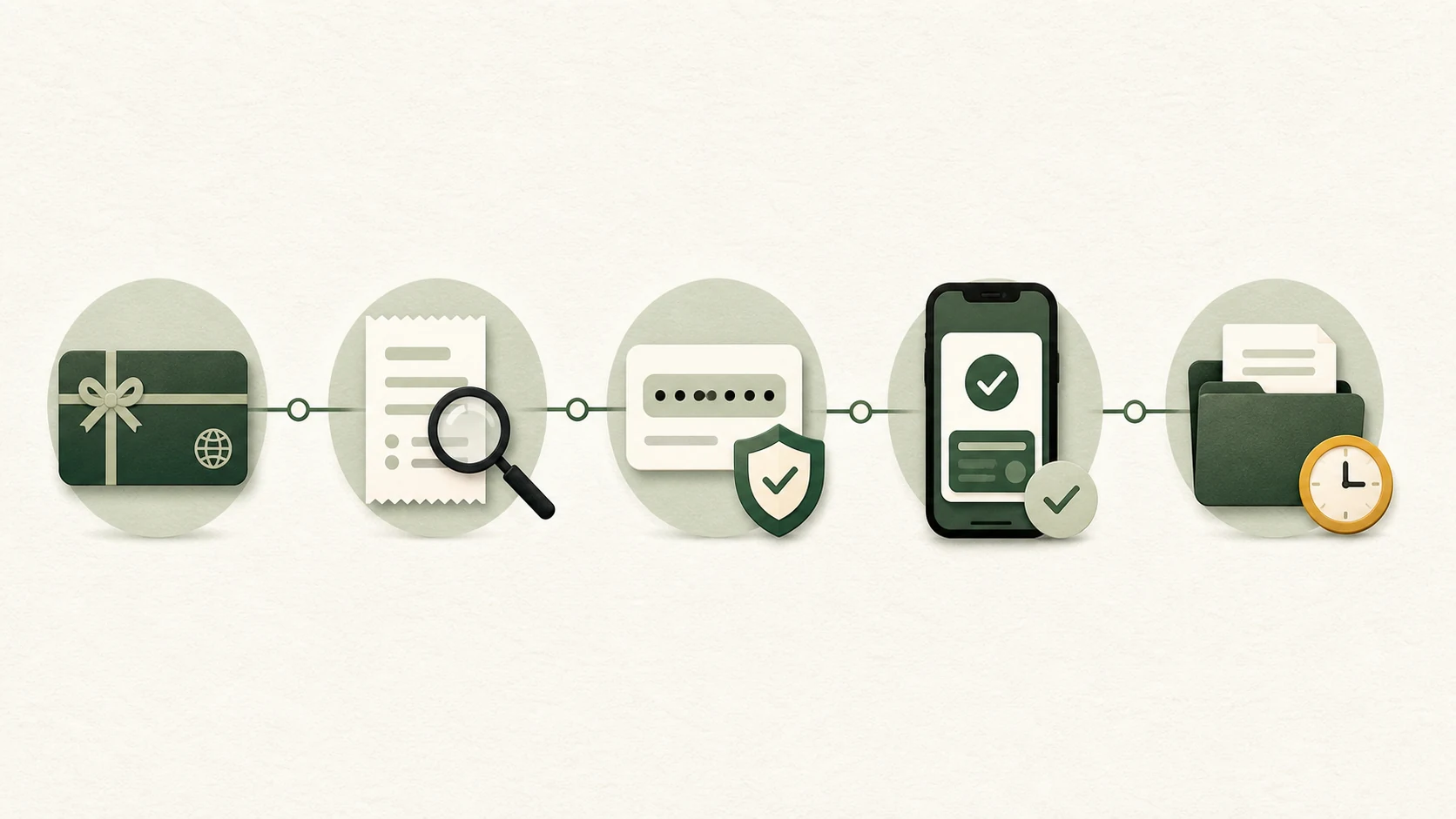
The nine checks at a glance
| Before the handoff | What to confirm | Why it matters |
|---|---|---|
| 1. Issuer rules | Whether the card can be transferred or resold | Some issuers restrict resale, cash exchange or use outside the brand |
| 2. Card identity | Brand, country, currency, amount and physical/e-code format | A quote for a different card is not a useful comparison |
| 3. Activation and source | Receipt, purchase email and retailer evidence | Helps separate a sourcing problem from a redemption problem |
| 4. Matching rate | Same brand, region, amount and format, with an update date | Old or mismatched rates create false expectations |
| 5. Transaction terms | Who verifies, when the code is disclosed and when payment becomes final | Removes dangerous ambiguity |
| 6. Safe preview | Redacted proof only; no full code, PIN, OTP or unnecessary personal data | Protects the value and your privacy |
| 7. Payment check | Actual credit in your own account, not a screenshot or forwarded alert | Fake notifications are a common seller scam |
| 8. Handoff record | Time, channel, agreed amount and evidence of delivery | Creates a usable timeline if there is a dispute |
| 9. Response plan | Issuer, bank/payment provider and reporting channels | Speed and complete evidence can matter after a problem |
1. Check the issuer’s rules before you negotiate
“Gift card” is a broad label, not one universal product. The issuer decides where a card works, whether it can be transferred, and what happens after redemption. Read the current terms for the exact card instead of assuming that every brand allows a cash resale.
Google Play is an important example. Google’s current gift-card guidance says Play gift cards may not be sold or exchanged for cash or another prepaid payment method, and cards bought through Google Play cannot be used commercially for resale. Apple’s gift-card scam guidance says its gift cards are for purchases from Apple and should not be used to pay unrelated people, bills or government charges.
That does not make every card identical. It means the safe first question is not “Who pays the highest rate?” It is “Does the issuer allow the transaction I am considering?” If the answer is unclear, pause and ask the issuer or original retailer.
2. Identify the exact card, not just the brand
Before requesting a quote, write down five non-secret details:
- the exact brand or product name;
- the issuing country or marketplace;
- the printed currency and face value;
- whether it is a physical card or an e-code; and
- whether you have the original receipt, packaging or purchase email.
A US Apple e-code and a UK Apple physical card are not interchangeable. A buyer may accept one format and reject another. If you are unsure how to state the details, use this guide to describe your gift card without exposing its code.
Do not post a full image of the back panel while asking for a rate. Crop or cover the redemption area, PIN, barcode and full serial number. The goal at this stage is to identify the product, not to give someone the product’s spendable value.
3. Separate activation, balance and purchase proof
These are three different questions:
- Was the card activated at purchase? A physical card may require activation by the retailer.
- Has the code already been redeemed? A redemption error can have several causes and should be handled through the issuer or retailer.
- Can you show where the card came from? A receipt or purchase email can support the source, amount and date.
Do not redeem a card to an account merely to “test” it if your plan is to transfer it. Redemption may bind the value to that account. Do not send the code to an unofficial “checker” or several potential buyers. If there is an activation or redemption problem, use the issuer’s official support path.
Purchase proof is useful, but it can expose your name, email, address, order number or payment details. Share only what the agreed verification process needs. Our explainer on why receipts affect buyer confidence shows which parts of a purchase trail matter without treating a receipt as a guarantee.
4. Compare only a matching, dated rate
A high-looking screenshot is not a reliable benchmark if it belongs to another country, amount, format or date. Match the card first, then compare the rate.
Use a page that identifies the brand, country, denomination or calculation method and displays when its data was updated. Treat the number as an estimate, not a guaranteed payout. The buyer may still consider source evidence, format, demand and verification risk.
This step-by-step method for checking a matching rate before selling explains the comparison process without using an exchange-rate shortcut.
5. Agree on the process before the code is visible
A safe transaction should have a clear sequence. Ask these questions before continuing:
- What information is needed for the initial quote?
- How will the buyer verify the card?
- At what exact step will the full code be revealed?
- Where will payment appear?
- When is the quoted amount final, and what can legitimately change it?
- What happens if the issuer reports an activation or region error?
- Which support channel handles a dispute?
If the answers keep changing, the quote is incomplete. A buyer who is ready to receive the code should be able to explain the handoff and dispute process without relying on urgency.
6. Share a redacted preview, not the value itself
For an initial assessment, the buyer may need to see the card type, face value, country clues, condition or receipt date. That does not require a readable redemption code.
Keep these private until the agreed handoff step:
- the full redemption code or PIN;
- one-time passwords and account verification codes;
- full card serial numbers when a partial number is enough;
- bank login details or recovery codes;
- unrelated receipt details such as home address or another card number; and
- an unprotected purchase-email link that opens the gift card.
The FTC’s gift-card scam guidance and major issuers consistently warn that once a stranger obtains the redeemable number, the funds can disappear quickly. Treat the code like cash, not like a product photo.
7. Verify payment in your own account
Do not release a code because a buyer sends a payment screenshot, an email alert or a message saying “successful.” The FTC’s guidance for avoiding scams when selling online identifies fake payment notifications as a known seller scam.
Open your own bank or payment app through the normal icon or saved address. Check the actual transaction history and available balance. Do not use a link supplied by the buyer. If the transfer is pending, reversed, unfamiliar or tied to a request that you first pay a “release,” “upgrade,” “verification” or “refund” fee, stop and contact the provider through its official channel.
An overpayment story is also a warning sign. If someone claims to have sent too much and asks you to return the difference, do not send money merely because a screenshot shows a larger amount. Ask your bank or payment provider to verify the transaction and advise on any reversal.
8. Build a simple evidence trail
Keep a small transaction folder until the deal is fully settled. It should contain:
- the original receipt or purchase email;
- a redacted image showing the card’s non-secret details;
- the agreed quote and terms;
- the buyer’s account or platform identifier;
- the date and time the code was handed over;
- the payment transaction reference visible in your own account; and
- support messages if something went wrong.
Do not edit screenshots in ways that obscure the timeline. Do not keep unnecessary copies of the full code across multiple chat apps and cloud folders. The evidence pack should document the transaction without creating more places where the value can leak.
9. Know what to do if the handoff goes wrong
If a code is exposed unexpectedly, a payment alert proves false, or a buyer demands a refund after receiving value, stop sending additional money or information.
Then:
- Contact the gift card issuer or original retailer using a verified website or phone number.
- Contact your bank or payment provider through its official app or support channel.
- Preserve the original messages, timestamps, transaction references and purchase proof.
- Report cybercrime or financial fraud through the Nigeria Police Force National Cybercrime Centre e-reporting portal.
- For a consumer dispute with a business, review the FCCPC complaint process.
Reporting does not guarantee recovery, but a clear record gives the issuer, provider or authority more useful information. Also be cautious of “recovery agents” who ask for another upfront payment.
For additional context, read our fact-check on refund claims after scam transfers. It explains why a viral promise of an automatic refund should not replace prompt reporting to the relevant provider.
Two quick scenarios
A careful handoff
A seller identifies a US physical card, keeps the code covered, shows a redacted receipt, compares a dated rate for the same format and agrees on the handoff sequence. The seller checks the actual bank account rather than the buyer’s screenshot, records the transaction reference, then stores the evidence in one folder.
This process does not guarantee there will be no dispute. It does reduce avoidable confusion about the card, quote, payment and timing.
A transaction to stop
A buyer offers an unusually high amount but will not explain the verification process. The buyer asks for the back-panel photo “just for a quick check,” sends a payment screenshot, then asks the seller to pay a release fee before the transfer can arrive.
The safe response is to stop. Do not expose the code, pay the fee or follow a link in the message. Verify independently through the bank, platform or issuer.
Frequently asked questions
Can a buyer check my gift card without seeing the full code?
A buyer can assess the brand, country, amount, format, condition and purchase proof from redacted information. Confirming redemption status may require an issuer-controlled process, but sending the full code to an unofficial checker or multiple buyers creates additional risk.
Is a payment screenshot enough before I send the code?
No. Check the transaction inside your own bank or payment account. A screenshot, email or chat notification can be altered or fabricated.
Should I redeem the card first to prove the balance?
Usually not if you intend to transfer the unredeemed card. Redemption can bind the value to an account. Use the issuer’s official help process for activation or redemption problems.
Does every gift card allow resale for cash?
No. Rules vary by issuer and country. Google Play, for example, states that its gift cards cannot be sold or exchanged for cash or another prepaid payment method. Check current issuer terms before proceeding.
What is the safest information to send for a quote?
Start with the brand, country, currency, amount, physical/e-code format and whether purchase proof exists. Keep the redeemable code, PIN, OTP and unrelated personal details private.
Final checklist
Before you reveal a gift card code, be able to answer “yes” to all of these:
- I checked that the issuer permits the transaction.
- I identified the exact country, currency, amount and format.
- I kept the full code and PIN out of the quote stage.
- I compared a dated rate for the same type of card.
- I understand the verification, payment and dispute process.
- I verified payment inside my own account.
- I saved the receipt, terms, timestamp and transaction reference.
- I know which official issuer, provider and Nigerian reporting channels to use.
If one answer is “no,” pause before transferring the value.
This article provides general safety information, not legal, financial or recovery advice. Issuer rules and payment processes can change; check the current terms for the exact card and service you use.