
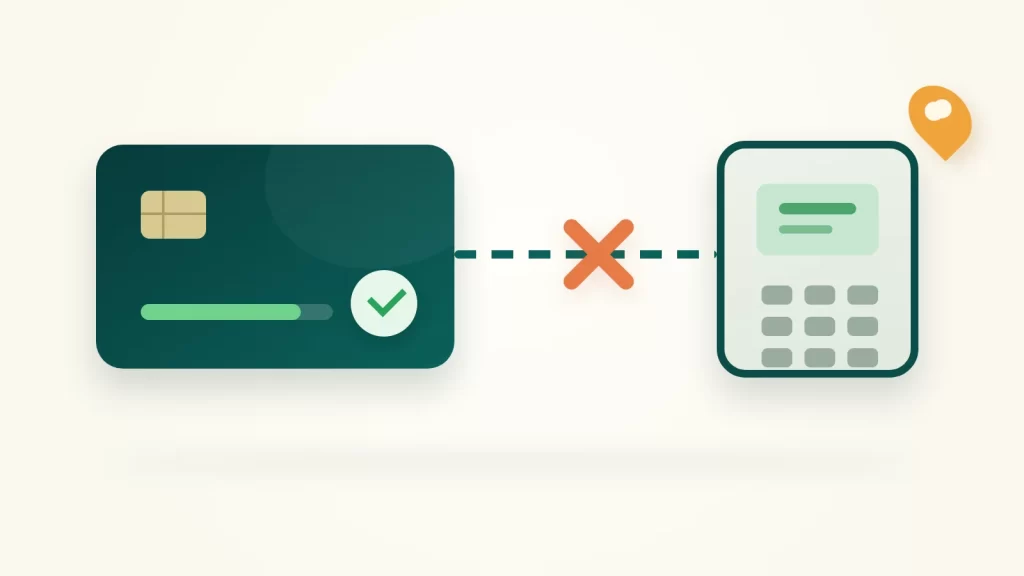
A Visa gift card can show a positive balance and still be declined. The balance page answers only one question: how much value the issuer currently shows. It does not confirm that the card is active for every merchant, every country or every type of transaction.
For a reader in Nigeria, check the card’s issuing country before trying anything else. Many Visa gift cards sold in the United States are domestic-use products. Visa says a card marked “Valid only in the United States” will not be accepted outside the US, and Vanilla says its Visa gift cards are for merchants in the United States and District of Columbia. A balance on one of those cards does not make it usable at a Nigerian shop or a Nigeria-based online merchant.
If the country is valid for the intended use, the next checks are the real available balance, the final checkout total, any pending authorization, the merchant type and the issuer’s security decision. Do not use a VPN, fake billing address or repeated rapid retries as a substitute for those checks.
Quick answer
When a Visa gift card has money but keeps declining:
- Read the front, back and cardholder agreement for country restrictions.
- Check the available balance and recent transactions on the issuer’s official site or phone line.
- Compare the balance with the full amount, including tax, delivery and possible preauthorization.
- Confirm that the purchase is not recurring, cash-like or another restricted transaction.
- For online checkout, enter the card as Visa credit or debit—not as a store gift card—and use only truthful billing details.
- Stop after one careful retry if the same error returns.
- Call the issuer shown on the card and ask for the decline reason or status.
The most useful question is not “Does the card have a balance?” It is “Why did the issuer or merchant reject this specific authorization?”
First separate balance from available balance
| What you see | What it means | What to check next |
|---|---|---|
| Card balance | The value recorded on the account | Look for pending transactions or fees that reduce what can be spent now |
| Available balance | The amount currently available for authorization | Compare it with the entire checkout total, not only the item price |
| Pending authorization | Money temporarily reserved for a transaction that may not have settled | Ask the issuer when the hold should release; do not count it twice as a completed charge |
Hotels, restaurants, car rentals and fuel merchants can request more than the final purchase amount. Visa’s gift-card guidance notes that hotels and car rentals may place holds, while a restaurant or issuer may authorize an amount above the bill for a possible tip. Vanilla’s current help page says some transactions may require a hold of up to 20% above the purchase amount.
That means a card showing $50 can still decline on a $50 checkout. Tax, shipping or a temporary authorization can push the requested amount above the available balance.
For Nigerians, check the country rule before troubleshooting the checkout
A US dollar card is not automatically an international card. Look for wording such as “Valid only in the United States” and identify the issuer behind the Visa logo.
Visa is the payment network; the bank or program manager issues the card and sets many of its terms. Different Visa gift-card programs can have different rules for international purchases, online transactions, subscriptions, digital wallets and replacement claims.
Visa explains that a domestic-use card will not work outside the United States. Vanilla’s official FAQ is even more specific: its physical and electronic Visa gift cards are intended for merchants in the United States and District of Columbia.
For someone physically in Nigeria, this creates two common mistakes:
- Trying a US-only card at a Nigerian merchant because the website displays prices in dollars.
- Assuming a global-looking website processes its payment through a US merchant account.
The currency on the screen does not prove where the merchant processes the transaction. If the card is domestic-use only, changing your phone region, using a foreign address or masking your location does not change the card agreement.
If you received the card for resale or a quote rather than personal spending, identify it accurately first. “Visa $100” is incomplete. A useful description is “US Vanilla Visa $100 physical card” or “US-issued Visa reward e-card,” with the issuer and format stated. Our guide to describing a gift card for the correct rate explains why those details matter.
This guide is for Visa-branded prepaid or gift cards that show funds but reject a purchase. If your product is a Google Play code and the error explicitly names a country, that is a different account-and-market problem; use our Google Play gift card country error guide instead.
Nine reasons a funded Visa gift card may be declined
| Possible reason | Clue you may see | Safe next step |
|---|---|---|
| Domestic-use restriction | The card says US-only, or the issuer limits use to US merchants | Do not retry from Nigeria; confirm the card agreement and intended market |
| Total exceeds available balance | The item fits, but tax, delivery or tip makes the final total higher | Reduce the purchase amount or ask whether split payment is supported |
| Authorization hold | A failed hotel, fuel, restaurant or rental attempt appears as pending | Ask the issuer when the hold will release before trying another purchase |
| Online security decline | The card works in person but one website cancels the order | Recheck CVV and truthful billing details, then try another eligible merchant or call the issuer |
| Restricted transaction | The purchase is recurring, cash-like, an ATM withdrawal or another excluded use | Choose a permitted purchase; do not try to route around the restriction |
| Merchant does not support partial authorization | The card balance is lower than the checkout total | Tell the cashier the exact amount to charge to the card before presenting another payment method |
| Card or account is on hold | The official status says “on hold,” blocked or suspended | Call the number on the card; repeated attempts will not remove an issuer hold |
| Card not fully activated | The balance or status page does not clearly show active status | Follow the issuer’s official activation steps or return to the original retailer with the receipt |
| Too many retries or inconsistent details | Several attempts fail across accounts, addresses or devices | Stop, preserve the error details and ask the issuer which control rejected the transaction |
This table is a diagnosis guide, not a promise that every issuer will reveal a detailed reason code. Visa directs cardholders with sufficient funds to contact the issuer at the number on the card when a purchase is declined.
Online checkout: small details matter, but they are not universal fixes
For an online purchase, Visa says to enter the 16-digit card number, expiration date and CVV. Vanilla adds that the card should be entered as a credit or debit payment method, not selected as a merchant “Gift Card,” and that the name and address fields should be completed.
Use your real information where the issuer permits it. Do not copy a random US address from the internet. Some programs let the user associate an address; others do not. A Reddit comment that worked for one card program may be wrong for a different issuer.
Check these details once:
- The number, expiration date and CVV were entered correctly.
- The checkout total includes tax, shipping and any temporary authorization.
- The merchant is located in a country permitted by the card.
- The transaction is a one-time eligible purchase rather than a subscription or cash-equivalent transaction.
- The name and billing information follow the issuer’s own instructions.
Adding the card to a digital wallet proves only that the wallet accepted the card credentials. It does not guarantee that the issuer will approve a later payment. Vanilla recommends a digital wallet only where that option is available and the merchant accepts wallet payments; it does not describe the wallet as a way to bypass country or merchant restrictions.
Split payment can help in a shop, but the cashier must support it
If your purchase costs more than the available balance, ask the cashier to charge an exact amount to the Visa gift card and take the remainder from another payment method.
For example, if the available balance is $18.40 and the total is $25, say:
Please charge exactly $18.40 to this Visa gift card first. I will pay the remaining $6.60 separately.
Visa’s Partial Authorization Service allows participating systems to approve the available amount and request another form of payment for the balance. But merchant policies and checkout systems still matter. Some online checkouts cannot split a payment even when an in-store terminal can.
Do not ask a merchant to “test” the full card number in chat. Present the card through the merchant’s normal secure payment flow.
What to ask the issuer after a careful retry fails
Call the official number printed on the card or listed in its documentation. Do not use a phone number supplied by a stranger, reseller or search advertisement.
Have these details ready without publishing them:
- Card program or issuer name.
- Last four digits—not the full number in ordinary email or chat.
- Available balance and status shown on the official service.
- Merchant name and country.
- Exact amount and currency.
- Date and time of the failed attempt.
- Whether the transaction was online, in-store or through a wallet.
- Any pending transaction or error message.
Use a clear support request:
My card shows an available balance of [amount], but a purchase for [amount and currency] at [merchant] was declined on [date and time]. The transaction was [online/in-store]. Please confirm whether the card is active, whether a pending hold reduced the available balance, and whether the decline came from a country, merchant-type, security or amount restriction.
Ask for a case number. If the agent cannot provide a reason, ask whether the card is eligible for that merchant and country rather than requesting a risky workaround.
If the card came from a seller or informal trade in Nigeria
Do not expose the full card number or CVV while trying to prove that the card has value. A balance screenshot can be edited, and anyone who receives the complete credentials may spend the card.
Preserve:
- The original listing or quote.
- The stated brand, issuer, country, denomination and format.
- The payment record and conversation.
- The exact decline message and time.
- The original receipt or order confirmation, if available.
If the seller described a US-only card as usable in Nigeria, focus the dispute on the inaccurate description. Do not pay an extra “activation,” “conversion” or “unlock” fee. If you only need Nigerian market context after identifying the card, compare the dated estimate on our $100 Vanilla Visa gift card value page; a rate page is not proof that a particular card will authorize a purchase or qualify for a trade.
Frequently asked questions
Why does my Visa gift card show a balance but decline online?
The issuer may reject the specific authorization because of the total amount, merchant location, online security checks, transaction type or card-program restrictions. Recheck the full total and official card terms, then contact the issuer if one careful retry fails.
Can I use a US Visa gift card in Nigeria?
Not if the card is marked for domestic US use or its agreement limits transactions to US merchants. A positive balance does not remove that restriction. Check the exact issuer terms instead of assuming every Visa gift card is international.
Will a VPN or US billing address make the card work?
Those are not legitimate fixes. A VPN does not change the issuing agreement, and a false address can create inconsistent account information or additional security declines.
Why does a $50 card decline on a purchase below $50?
Tax, shipping, tips or a preauthorization may raise the amount sent for approval. A pending hold can also reduce the available balance even when the headline balance still looks sufficient.
Can I combine two Visa gift cards?
It depends on the merchant. Vanilla says its cards cannot be merged into one balance, though a retailer may allow multiple cards or split payment. Ask before the transaction and provide the exact amount for each card.
Should I keep retrying at different websites?
No. Repeated attempts do not fix a country restriction or issuer hold and may make the transaction history harder to interpret. Record one failed attempt and contact the issuer or original seller with consistent details.
Who should I contact: Visa, the shop or the issuer?
For a decline on a funded card, start with the issuer or program manager shown on the card. The retailer is the first contact when activation at purchase is in doubt. Visa’s own support guidance directs card-specific decline questions to the issuing institution.
Bottom line
A visible balance is useful evidence, but it is not a universal approval signal.
For Nigerians holding a foreign-issued Visa gift card, the issuing country is the first check. If the card is valid only in the United States, stop trying to use it locally. If the country is appropriate, compare the real available balance with the full authorization amount, check for holds and restricted transaction types, then ask the issuer about the specific decline.
That approach is slower than copying a one-line Reddit trick, but it protects the card, produces a cleaner support case and avoids turning a simple decline into a security problem.
Card rules and support options vary by issuer. Policy details last checked against Visa and Vanilla help pages on 6 September 2026.