
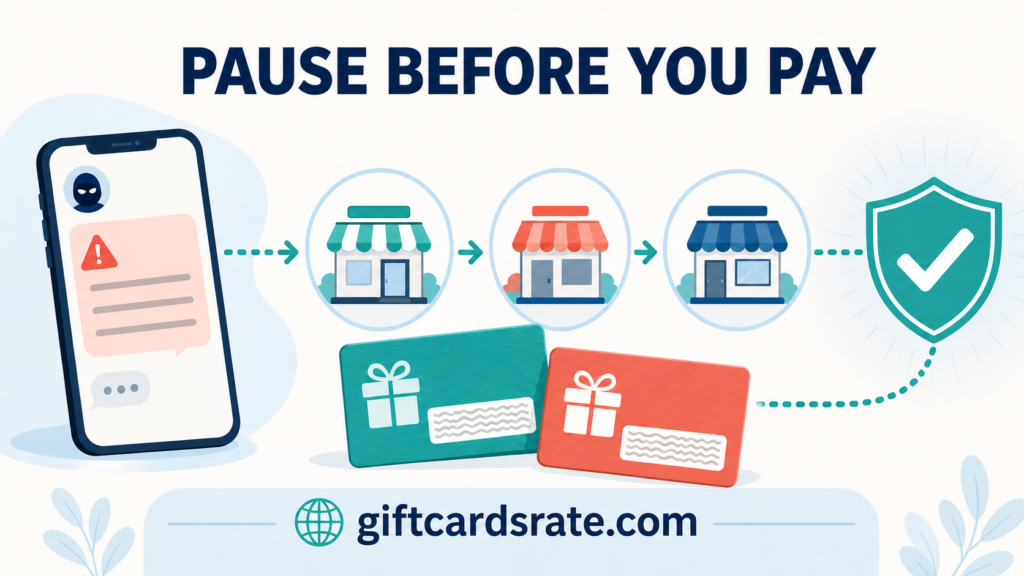
Quick answer: if someone is directing a buyer to purchase gift cards at several stores, avoid staff questions, invent a cover story, or send card numbers immediately, stop the transaction. For a Nigerian gift card seller, that pattern is not proof that a particular card is stolen, but it is a serious source-risk signal. Protect the live code, verify who bought the card and why, check the issuer’s rules, and do not accept urgency as a substitute for evidence.
That warning gained fresh official support on 20 August 2026, when Consumer Protection in Western Australia published a media release about gift card scams. The release says scammers may impersonate an employer, government agency, business, manager or romantic partner. It also says some victims are coached on what to tell retail staff and are sent to several stores so that one unusual purchase is split into smaller transactions.
This is Australian consumer-protection news, not Nigerian law and not a Nigerian loss report. Its value for Nigerian users is narrower and practical: it describes what can happen before a code appears in a resale chat or marketplace. A card can look technically valid while its purchase was driven by deception.
What the Western Australia warning reports
The release gives three examples. One new employee reportedly bought Apple and Microsoft gift cards over three days after receiving emails that appeared to come from the company’s chief executive. Another person reportedly continued sending gift cards to an overseas love-interest even after retail staff warned her. A man in his late seventies was described as losing money in a similar relationship scam.
The page prints figures of more than $17,000, $77,000 and about $50,000. It does not label the currency in the article text, so those figures should be repeated only as source-reported examples. They should not be converted into naira, added together as a market estimate, or used to claim how common the problem is in Australia or Nigeria.
| Official source detail | What it can show | What it does not prove |
|---|---|---|
| A supposed CEO directs an employee to buy cards | Workplace identity and authority can be impersonated | That every unusual employer request is criminal |
| A buyer is warned by store staff but continues | Trust and emotional pressure can override a warning | That refusing one purchase will stop the whole scam |
| The buyer visits several stores | The person may be following instructions designed to avoid scrutiny | That shopping at more than one store is automatically fraud |
| Card numbers are sent soon after purchase | Value may be used or resold quickly once the credential is exposed | That an issuer or marketplace can always recover the value |
Why several stores is an important signal
Retail controls often work at the point of purchase. A cashier may notice a large quantity, repeated denominations, visible phone instructions, unusual nervousness, or a story that changes when questions are asked. A warning sign and a short conversation can give the buyer time to pause.
The Western Australia release says scammers adapt to those controls. They may tell the victim to say the cards are birthday gifts or to move between stores. Splitting purchases can reduce the chance that any one cashier sees the full pattern. The operational lesson is not that multiple receipts equal guilt. It is that a seller should ask for a coherent, privately documented source explanation instead of evaluating only the last receipt or the visible balance.
The government’s earlier Scam Awareness Week infographic PDF identifies urgency, mismatched email addresses, requests for personal information and unusual payment methods—including gift cards—as warning signs. The PDF is linked as official public guidance; it is not evidence that the sender in any individual Nigerian transaction is a scammer.
The question a Nigerian seller should ask first
Before asking “What is the rate?”, ask “Why does this person control the card?” A genuine owner should usually be able to explain who bought it, where it came from, how it was activated and why it is being sold. The explanation does not need to expose unnecessary personal data, but it should be consistent with the receipt, card region, format and timing.
A receipt helps, but it is not conclusive. It can be cropped, reused, altered, detached from a different card or produced by a person who was manipulated into making the purchase. Our guide to why purchase evidence affects gift card acceptance explains why the whole record matters more than one screenshot.
| Intake signal | Safe seller response | Evidence to preserve privately |
|---|---|---|
| Buyer says a boss, official or online partner instructed the purchase | Pause; ask the buyer to verify that person through a separate known channel | Original message metadata, sender address and verification outcome |
| Several same-day receipts from different stores | Request a consistent source explanation; do not assume the receipts settle ownership | Complete receipts, activation lines, dates and card identifiers with live codes covered |
| Buyer is being coached during the trade | Do not continue while a third party controls the conversation | Platform account, timestamps and non-sensitive screenshots |
| Pressure to reveal the full code before checks | Keep the code hidden until the counterparty and process are authenticated | Cropped card image, issuer/region details and agreed workflow |
| Story changes when basic questions are asked | Decline or escalate for enhanced review | Both versions of the explanation without publishing personal data |
A 90-second check before accepting a code
- Separate the buyer from the requester. Ask whether anyone is currently instructing them by phone, email, chat or remote-access software.
- Identify the issuer and region. Confirm the exact card product and the country or account restrictions from the issuer’s official site.
- Check the source story. Compare the buyer’s explanation with the complete receipt, activation record, dates and purchase location.
- Protect the credential. Do not ask for a live code in public comments, social media, an unknown balance checker or an unauthenticated support chat.
- Apply issuer rules. A technically redeemable card is not automatically transferable. The issuer’s terms can restrict resale, exchange, region or use.
- Pause on coercion signals. If the buyer mentions secrecy, arrest, a boss’s urgent task, an overseas emergency or instructions to visit multiple stores, stop and verify independently.
Issuer rules still matter after the scam check
Apple’s official gift card scam page says Apple gift cards are for Apple products and services and warns against sharing redemption codes with strangers. It also provides a route to contact Apple Support about an Apple gift card scam.
Google Play’s official scam guidance says a request to buy a Play gift card and use its code for something outside Google Play is a scam sign. It also states that Google Play gift cards cannot be resold, exchanged or transferred for value. That is a specific Google Play limitation, not a rule that should be silently generalized to every gift card brand.
This is why source verification and issuer compliance are separate checks. A card may come from a genuine purchaser but still be unsuitable for resale under its issuer terms. Conversely, an apparently acceptable card format does not prove that the purchase was voluntary or lawful.
If you are the person being told to buy the cards
- Stop before payment. Do not move to another store or invent a cover story for the requester.
- Verify the person separately. Call your employer, relative or agency using a number you already know or find independently on its official site.
- Do not share the card number, PIN or photograph. A picture can transfer the redeemable credential even when you still hold the plastic card.
- Keep the card and receipt. Preserve the original packaging, full receipt, activation record and messages.
- Contact the issuer and payment provider promptly. Ask what fraud steps are available, but do not assume recovery is guaranteed.
A related Australian Scamwatch alert updated for July 2026 describes messages about fake purchases that push recipients to call a supplied number. It warns that a caller may eventually ask the person to buy gift cards and send photographs. Its recommended pattern is to stop, check through the real app or official website, and act quickly if money or information was shared.
Reporting paths depend on where the incident happened
For an incident connected to Western Australia, the media release points to WA ScamNet. A Nigeria-based victim can report cyber-enabled fraud through the Nigeria Police Force National Cybercrime Centre e-reporting portal. Also notify the card issuer, the retailer, the bank or payment provider used for the purchase, and the platform where the request occurred.
Report only through independently located official channels. Keep unredacted codes private unless an authenticated issuer or authorized investigator specifically requires them. Reporting can help preserve evidence and may support an intervention, but no authority, issuer or platform can promise that exposed value will be recovered.
Frequently asked questions
Does buying cards at several stores prove fraud?
No. There are legitimate reasons to shop at more than one retailer. In the Western Australia warning, the importance of the pattern is that scammers may direct victims to split purchases to avoid questions. Treat it as a reason to verify, not as a verdict.
Is a complete receipt enough to accept the card?
No. A complete receipt is stronger than a crop, but it does not by itself establish who controlled the purchase, whether the buyer was coerced, or whether the card can be resold under issuer rules.
Should a seller test the code in a third-party balance checker?
No. Do not expose an unredeemed code to an unknown checker. Use issuer-approved support and a controlled transaction process. Our safe-selling checklist for Nigerian users covers code protection in more detail.
Can a seller recover money if the issuer later freezes the card?
There is no universal answer. Contract terms, evidence, timing, issuer rules and the platform process all matter. Preserve records and contact the relevant issuer or platform, but do not rely on a guaranteed refund.
Sources and editorial note
News context reviewed 25 August 2026. This article reports an official Western Australian consumer-protection warning and applies its retail-intervention lesson to source checks for Nigerian gift card users. It is not legal advice, does not claim Western Australian law applies in Nigeria, does not identify any unnamed person as a criminal, and does not set or predict gift card rates.
- Western Australia Consumer Protection: gift card scam media release
- Government of Western Australia: Scam Awareness Week infographic PDF
- Australian Scamwatch: fake purchase callback alert
- Apple Support: About gift card scams
- Google Play Help: gift card scam reporting and restrictions
- WA ScamNet
- Nigeria Police Force National Cybercrime Centre e-reporting portal