
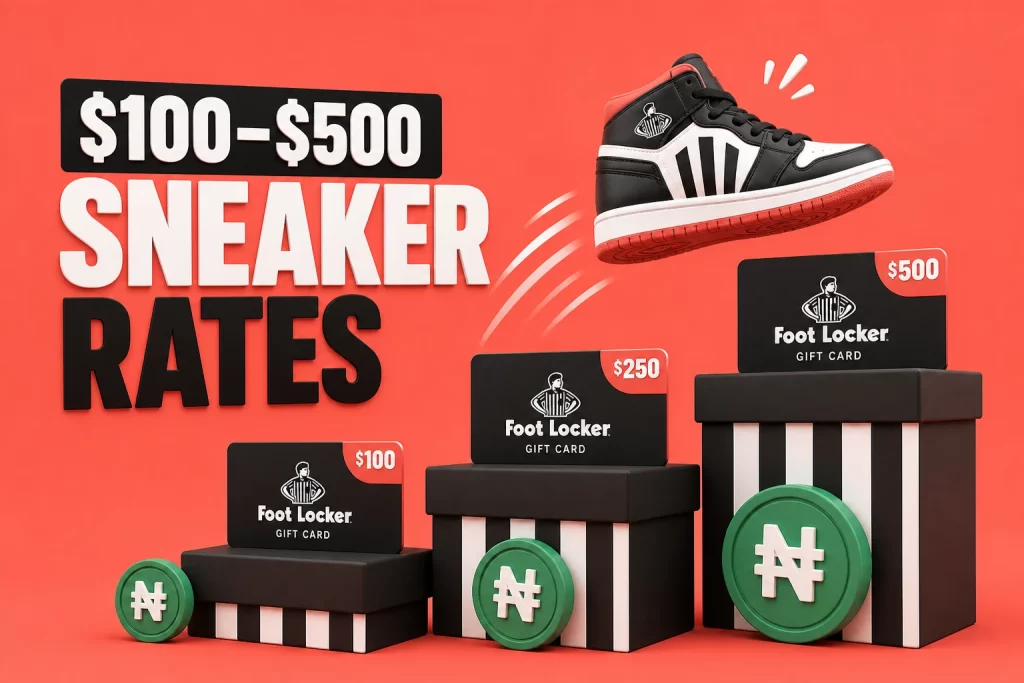
Foot Locker cards can show a strong naira rate, but a $500 total needs careful wording. Foot Locker’s current US terms say a single card can be loaded from $10 to $250. A seller describing ‘$500 Foot Locker’ may therefore mean two $250 cards or another multi-card combination, not one standard $500 card.
Latest USA Foot Locker rate
Live tracked rate: Historical reference: 1222.73₦ (previous dataset) per dollar. Table date: 2026-09-13.
The 2026-07-17 row was NGN 1,222.73 per dollar. It provides the base for the examples below, while the live row should be used for a later transaction.
Across the seven latest rows through July 17, the tracked rate stayed between about NGN 1,218.06 and NGN 1,226.61. That range changes a $250 estimate by roughly NGN 2,138 from low to high. Use it to understand ordinary movement before assuming every difference is an amount-tier penalty.
| Face value | Likely card count | July 17 estimate |
|---|---|---|
| $100 | One card | NGN 122,273 |
| $250 | One card at the stated maximum | NGN 305,683 |
| $500 total | Usually two or more cards | NGN 611,365 |
The official denomination limit changes the quote
Foot Locker’s US gift card terms list values from $10 to $250 and allow up to five gift cards per transaction. The same terms cover both physical and digital or email cards.
Two $250 codes create a $500 total but also create two balances, two code histories and two verification points. A buyer may quote the same per-dollar rate, or may adjust for the added work. State the card count before asking for a final offer.
Two current $250 cards still fit within Foot Locker’s limit of up to five gift cards per transaction. That does not guarantee a buyer will combine them, but it shows the $500 total is operationally different from an impossible single-card denomination. The article therefore reports $500 as an aggregate example.
Physical and email cards have different evidence
The official Foot Locker redemption guide explains that current cards use a 16-digit number and PIN. An older physical card without a PIN may be limited to in-store use, while older certificate formats can follow different rules. That product detail can materially affect buyer demand.
For an email card, retain the delivery message and order reference. For a physical card, photograph the denomination, PIN covering and receipt without exposing the usable number.
Older certificate formats deserve extra care because their number length and redemption channels can differ from current cards. A buyer who accepts modern 16-digit cards may reject an older paper certificate. Photograph the product name and instructions so the format can be identified before any rate is applied.
Worked quote comparison
Suppose one buyer offers NGN 1,215 per dollar for two $250 cards and another advertises NGN 1,225 but accepts only one card. The first offer produces NGN 607,500 for the complete $500 total. The second headline rate is not usable unless the buyer confirms both cards. Eligibility matters before arithmetic.
The USA Foot Locker rate page provides the newest baseline. Record each buyer’s accepted card count and total payout beside it.
Prepare the transaction accurately
- List every card and denomination separately.
- Confirm the cards are US Foot Locker products.
- Identify physical, email or older certificate format.
- Keep official balance evidence and receipts.
- Do not advertise one $500 card if the total is split across cards.
Rate conclusion
Use the current per-dollar row for $100 and $250 calculations. For a $500 total, calculate the same base value but disclose the number of cards and obtain a quote that covers all of them. That small distinction makes the article and the transaction substantially more accurate.
The Rate Methodology separates issuer denomination limits from market-rate calculations, which is essential when discussing a $500 multi-card total.