
Minnesota has brought gift cards into its organized retail theft law, a change that matters beyond one U.S. state because stolen codes and resale proceeds can move across borders quickly. H.F. 3155 became Chapter 74, was signed on May 7, 2026 and took effect August 1, 2026. The law covers physical and digital gift cards, including cards that have not yet been activated.
Quick answer: Minnesota did not make every failed, discounted or disputed gift card an organized-retail-theft case. The offence still requires a retail theft enterprise, a prior pattern of qualifying theft conduct and another covered act. For Nigerian sellers, the useful lesson is narrower: verify ownership, the chain of custody, packaging and transaction purpose before accepting value that may have originated abroad.
What took effect in Minnesota on August 1
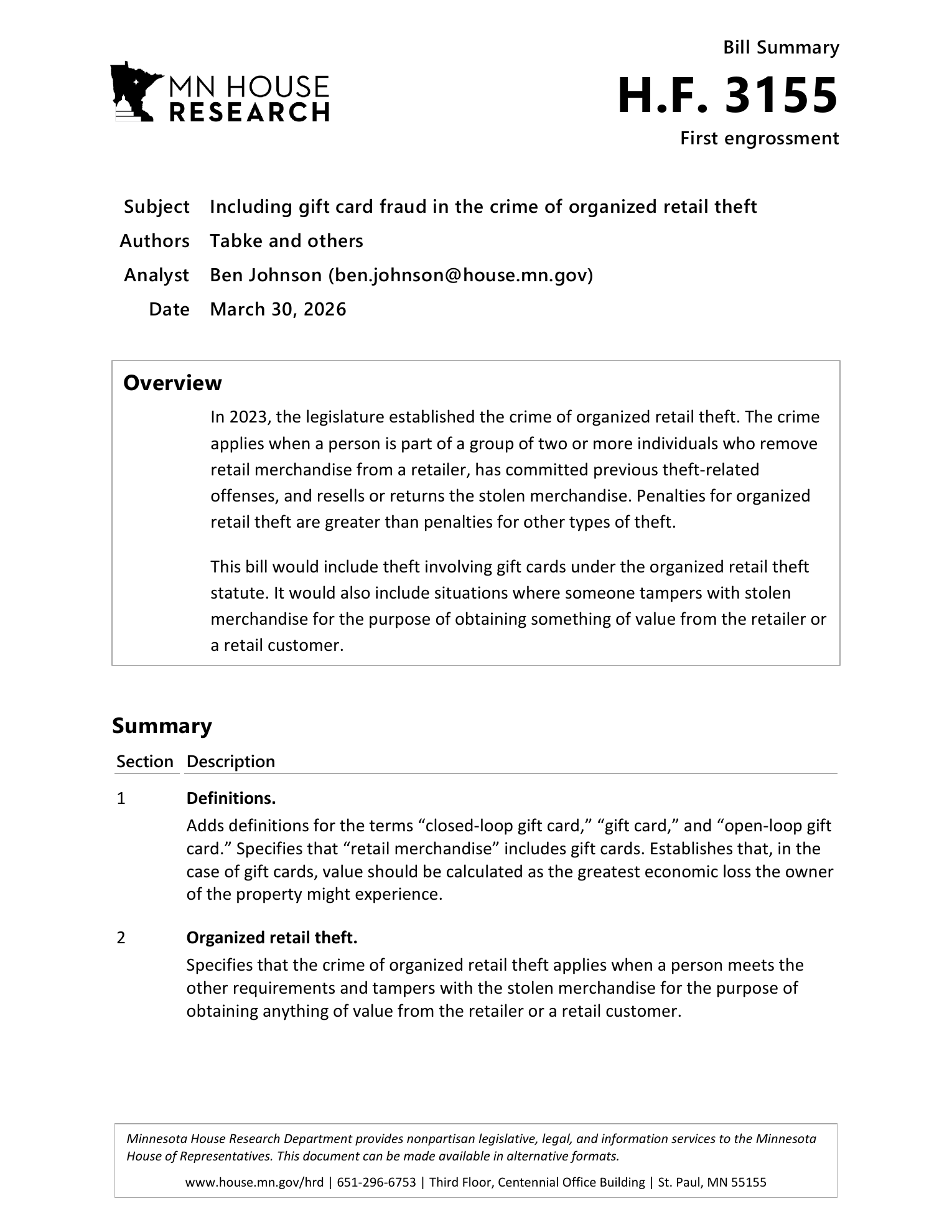
The official Minnesota Session Law, Chapter 74, amends section 609.522 of the state statutes. It defines a gift card as a physical or digital open-loop or closed-loop card, whether activated or not activated, and adds all gift cards to the meaning of retail merchandise.
The law also changes how gift card value is measured for this offence. Instead of looking only at money already taken, value can be the greatest economic loss the owner might reasonably suffer, including the full face value or the potential value of a variable-load card.
A further amendment adds tampering with stolen retail merchandise or its packaging for the purpose of obtaining something of value from a retailer or retail customer. The Minnesota House’s plain-language summary explains the practical scenario: thieves may steal codes or PINs before a card is sold, wait for a retailer to activate the card and then take the loaded value.
The important limit: this is not a one-fact offence
Headlines can make the amendment sound broader than it is. Under the statutory structure, organized retail theft requires several connected facts. A person must be employed by or associated with a retail theft enterprise, defined as a group of two or more people with a shared goal involving unauthorised removal of retail merchandise. The person must also have a prior pattern of qualifying retail theft conduct and intentionally commit or direct another covered act.
The law defines that prior pattern as relevant acts on at least two separate occasions in the preceding six months. It then requires an additional outcome: a member of the enterprise resells or intends to resell the stolen merchandise, advertises it, returns it for value, or tampers with it or its packaging to obtain value.
That distinction matters. A scratched panel, an invalid code or a seller who cannot immediately find a receipt may justify pausing a trade, but one fact alone does not establish every element of Minnesota organized retail theft. Evidence, intent and the full statutory conditions still matter.
Potential value can affect the seriousness of a case
The existing Minnesota organized retail theft statute uses value-based sentencing tiers. Because Chapter 74 now gives gift cards a potential-loss valuation rule, an unactivated or variable-load card may be assessed by the economic loss the owner could reasonably suffer, not merely the amount already redeemed.
| Property value in the statute | Listed maximum sentence | Gift card relevance |
|---|---|---|
| $500 or less | 364 days and/or a $3,000 fine | Prior convictions can affect how a lower-value case is treated |
| More than $500 up to $1,000 | Two years and/or a $5,000 fine | The valuation may consider potential card loss |
| More than $1,000 up to $5,000 | Seven years and/or a $14,000 fine | Qualifying conduct can be aggregated within six months |
| More than $5,000 | 15 years and/or a $35,000 fine | This is the highest listed value tier, not an automatic sentence |
These are statutory maximums for Minnesota organized retail theft, not automatic punishments for card tampering. The statute also contains prior-conviction rules, six-month aggregation and enhanced penalties where conduct creates a reasonably foreseeable risk of bodily harm. A court determines how the law applies to proved facts.
Why this is part of a wider 2026 policy trend
Minnesota chose to place gift card conduct inside its organized retail theft framework. Other states have taken different legislative routes. Virginia’s 2026 update to section 18.2-193 treats intentional gift card or packaging tampering with intent to defraud as gift card forgery. Maryland’s Chapter 457, effective October 1, 2026, creates a gift card forgery misdemeanor and sets a gift card valuation method for theft cases.
The differences are important. There is no single new nationwide rule saying every questionable gift card is organized crime. State lawmakers are using different definitions, offence elements, valuation rules and penalties to address card-rack tampering, stolen redemption information and resale chains.
Our earlier report on Georgia’s H.B. 447 explains another model: separate offences for gift card theft, forgery and fraud. Minnesota’s model is narrower in structure because it connects the new gift card language to the existing elements of organized retail theft.
Why Nigerian gift card sellers should care
Minnesota law does not govern an ordinary gift card trade in Nigeria, set Nigerian prices or make legitimate resale unlawful. The connection is operational rather than jurisdictional.
A card code photographed in a U.S. store can be sent through a messaging app, sold through multiple intermediaries and offered to a Nigerian buyer before the original retail purchaser discovers that the value is gone. By the time a downstream trader sees the card, the physical packaging and original purchaser may be thousands of kilometres away.
This means a visible balance is only one question. A legitimate acceptance process should also ask who owns the card, whether the seller had permission to transfer it, how the code was protected, and whether the transaction is part of a wider conversion chain.
A five-gate risk screen before accepting a card
| Gate | Useful evidence | Reason to stop |
|---|---|---|
| Ownership | Purchaser identity, gift explanation or documented authority to sell | The seller cannot explain why the card belongs to someone else |
| Purchase and activation | Complete receipt, order email or activation record kept privately | Only a cropped screenshot is available, or dates and card details conflict |
| Packaging and code | Intact seal, consistent serial details and an unrevealed scratch panel | Replacement labels, lifted seals or evidence that the code was exposed |
| Chain of custody | A clear account of each person or platform that handled the card | Several unknown intermediaries, changing stories or pressure to skip checks |
| Transaction purpose | A normal sale with named parties and a documented payment route | Instructions to redeem goods, forward electronics, convert to crypto or split proceeds |
Do not request or expose the complete code merely to satisfy an early screening step. Redact redemption information from initial proof, and never enter an unredeemed code into an unknown balance checker, sponsored result or lookalike support website. Use the issuer’s independently confirmed official channel or the established controls of a trusted platform.
What the Minnesota law does not mean
- It does not automatically apply to gift card transactions in Nigeria.
- It does not make every resale, low price, damaged package or failed code a crime.
- It does not replace the need to prove the enterprise, prior pattern, intent and other statutory elements.
- It does not create a new NGN rate, payout formula, trading fee or platform rule.
- It does not prove that an individual committed an offence before evidence is tested through the proper legal process.
What to do when a card fails the risk screen
- Pause the transaction. Do not redeem, resell, forward goods or convert the value while ownership is unclear.
- Protect the redemption information. Keep the full code, PIN, barcode and serial data out of public messages and screenshots.
- Preserve the original record. Save receipts, order emails, activation slips, packaging photos, messages, payment records and timestamps without editing them.
- Contact the issuer through an official channel. Confirm the domain or phone number independently instead of using a link supplied by the seller.
- Report through the right platform. Give factual evidence to the trading platform, bank, payment provider or relevant authority without making an unsupported public accusation.
The U.S. Federal Trade Commission tells scam victims to contact the gift card company promptly, ask whether funds can be recovered and report the scam. Nigerian users should also follow the reporting process of their bank, payment provider, platform and local authorities. For a broader preventive workflow, see our nine checks for selling gift cards safely in Nigeria.
Frequently asked questions
Does H.F. 3155 cover digital gift cards?
Yes. Chapter 74 defines gift cards to include physical or digital open-loop and closed-loop cards, whether activated or not activated.
Is packaging damage enough to prove organized retail theft?
No. Packaging damage is a warning sign, not proof of every element. Minnesota’s organized retail theft offence requires the connected enterprise, prior-pattern, intentional-conduct and resale, return, advertising or tampering conditions described in the statute.
Can an unactivated card have legal value under this law?
The amendment expressly includes cards that are not activated. For valuation, it allows the greatest economic loss the owner might reasonably suffer, including the potential value of a variable-load card.
Does the law change gift card rates in Nigeria?
No. The statute does not set exchange rates or Nigerian resale prices. Card value in a legitimate trade still depends on factors such as brand, issuing country, denomination, format, proof, buyer demand and current market conditions.
Sources and editorial note
News context reviewed August 16, 2026. This article summarizes U.S. state legislation and official consumer guidance for general information. It is not legal advice and does not claim that Minnesota law governs Nigerian transactions.
- Minnesota Office of the Revisor of Statutes: Chapter 74 / H.F. 3155
- Minnesota Statutes section 609.522: organized retail theft
- Minnesota House: organized retail theft statute expanded to gift cards
- Minnesota House Research Department: H.F. 3155 Bill Summary PDF
- Virginia Code 2026 update: credit card and gift card forgery
- Maryland General Assembly: Chapter 457 / H.B. 752 PDF
- Federal Trade Commission: avoiding and reporting gift card scams