
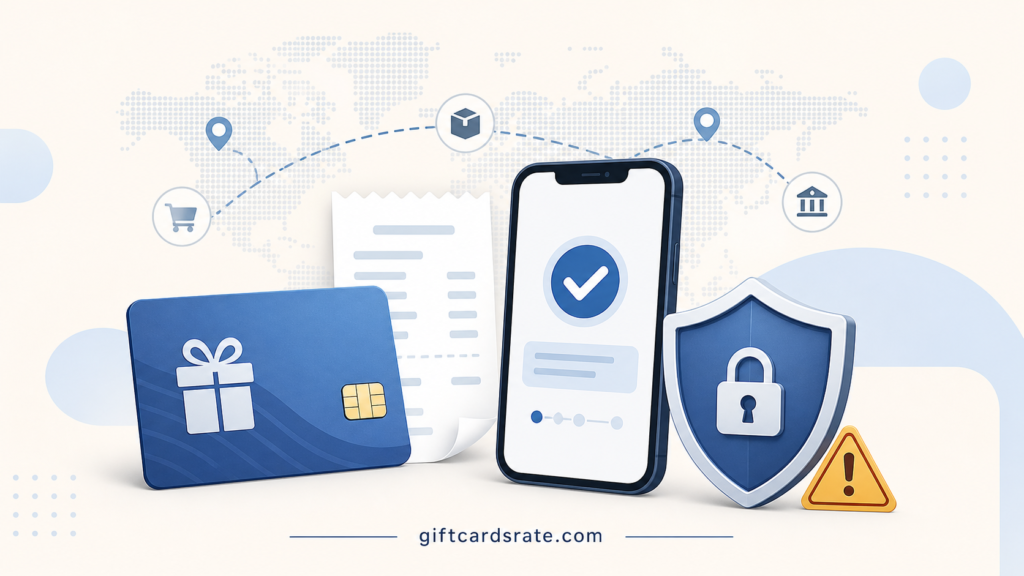
A July 2026 U.S. gift card fraud indictment is a useful warning for Nigerian sellers: a card can show value and still carry serious source risk. The case does not set gift card rates in Nigeria, and an indictment is not a conviction. What it does show is how stolen cards can move from romance fraud, elder fraud, hacking and theft into electronics purchases, cryptocurrency payments and international resale networks.
Quick answer: Before selling a gift card, verify where it came from, keep proof of purchase, avoid acting as a middleman for a stranger and never treat an unusually cheap card as automatic profit. A valid balance check cannot prove that a card was obtained lawfully.
What the July 2026 case alleges
On July 22, 2026, the U.S. Department of Justice announced that a federal grand jury had indicted a Chinese national in an alleged international gift card fraud conspiracy. According to the DOJ, the accused and alleged co-conspirators acquired gift cards stolen through romance fraud, elder fraud, hacking, theft and other scams. The cards were allegedly used to buy high-value electronics, which were consolidated in New Hampshire and shipped to China.
The DOJ also alleged that the group used WeChat to coordinate purchases and sales and used cryptocurrency for payments. Investigators said electronics found at the warehouse were connected to gift cards fraudulently obtained from victims in several U.S. states. The wire-fraud conspiracy charge carries a maximum statutory penalty of 20 years, but the DOJ stresses that the indictment is only an allegation and that the defendant is presumed innocent unless proven guilty.
This was not the first public warning linked to the investigation. In March 2026, the U.S. Attorney’s Office for New Hampshire said foreign criminal organizations had stolen millions of dollars in gift cards through scams, card tampering and network intrusions, then used the value to buy and export expensive electronics.
Why this news matters to Nigerian gift card sellers
The case took place in the United States, not Nigeria. It does not create a new Nigerian trading rule, change the dollar-to-naira exchange rate or prove that ordinary gift card resale is criminal. The practical connection is provenance: once a code enters a secondary market, the next buyer may see only the brand, country and balance—not the scam, theft or account takeover that produced it.
The U.S. Treasury’s 2026 National Money Laundering Risk Assessment explains why authorities pay attention to this market. It says prepaid and gift cards can attract abuse because they are transferable, portable and easy to convert into goods. The report describes schemes in which stolen or fraud-funded cards are sold at a discount or used to buy high-value products for resale.
For a legitimate Nigerian seller, that creates a simple risk: a buyer may reject, delay or dispute a card if its source cannot be explained. A platform may also freeze a transaction when a brand later flags the card, even if the person currently holding the code was not involved in the original fraud.
Seven lessons to use before you trade
1. Ask how the card was obtained
“The balance is valid” is not a complete source explanation. A safer card has a coherent origin: it was purchased by the seller, received as a genuine gift, earned through a documented promotion or obtained through another lawful channel that can be explained. Be cautious when a stranger cannot say who bought the card, where it was purchased or why it is being sold.
2. Keep the receipt without exposing the code
A store receipt, purchase email or order record can help connect a card to a legitimate transaction. Keep an unedited original for disputes, but redact the full claim code, PIN, barcode and sensitive account information when you are only proving the source. Read our guide to why receipts and proof affect gift card rates before sending evidence to a buyer.
3. Do not become a stranger’s conversion agent
Walk away if someone sends you cards and instructs you to convert them into cryptocurrency, buy electronics, forward goods or split proceeds across several accounts. Those steps resemble the conversion chain described in the DOJ allegations. A promise that you may keep a commission does not make the source clean.
4. Treat urgency as a risk signal
The FTC says gift card scams often use panic, secrecy and precise instructions. Common stories include a government payment, a boss who urgently needs cards, a family emergency, technical support or an online romantic partner. Apple’s current scam guidance similarly warns that scammers may build trust, show romantic interest and then demand redemption codes.
If the card came from one of those situations, stop the transaction. No legitimate government agency requires payment through an Apple, Google Play, Amazon or other retail gift card.
5. A very low price can reflect hidden risk
A steep discount is not proof of fraud, but it should trigger more questions—not faster payment. Criminal networks may accept less than face value because speed matters more to them than a normal market return. Compare a quote with current market information, then verify the country, card format, amount and source before deciding. Our gift card rate checking guide explains how to compare the correct row without assuming the highest number applies to every card.
6. Do not rely on screenshots alone
A screenshot can be edited, reused or sent to several buyers. It also cannot show whether a payment was later reversed or whether the card was obtained through an account takeover. Ask for the minimum evidence needed to understand the source and use the brand’s official support process when a card shows an activation, country or redemption problem.
7. Report a suspected scam quickly
If a scammer obtained the code, contact the card issuer immediately and keep the card and receipt. The FTC says some companies may be able to freeze remaining funds or consider a refund, although recovery is not guaranteed. Apple asks affected users to contact Apple Support. Google directs victims to its gift card scam reporting process and local law enforcement.
A five-minute source check
| Check | Lower-risk answer | Reason to pause |
|---|---|---|
| Origin | The seller can explain who purchased or received it | The source is vague, changes or involves a stranger online |
| Proof | Receipt or purchase email matches the brand, amount and date | Only a cropped screenshot is available |
| Instructions | You are selling your own lawful card through a clear process | You are told to buy goods, send crypto or forward proceeds |
| Pressure | There is time to verify the card and buyer | Someone demands secrecy or immediate conversion |
| Code privacy | The full code is shared only at the defined transaction step | A stranger wants the code before identity and process checks |
What to do if you already received a suspicious card
- Stop moving the value. Do not redeem, resell, split or convert the card while the source is in doubt.
- Preserve the evidence. Save the original messages, receipt, transaction reference, sender details and timestamps. Do not edit the originals.
- Contact the issuer through its official site. Do not use a phone number or link supplied by the person who sent the card.
- Notify the trading platform or payment provider. Give factual details without guessing about who committed a crime.
- Report suspected fraud to the appropriate authorities. If the transaction involves Nigeria, use the reporting route recommended by your bank, payment provider or local law enforcement. If the victim is in another country, the issuer or that country’s consumer-protection agency may provide the correct reporting path.
Do not post the code publicly while asking for help. Apple warns that once a stranger has the code, the funds may be spent before the victim can reach Apple or law enforcement. Google also says never to share a Play gift card redemption code.
What this case does not prove
- It does not mean every discounted gift card is stolen.
- It does not mean every reseller or Nigerian gift card trader is involved in fraud.
- It does not create a new gift card exchange rate or guarantee lower payouts.
- It does not establish the defendant’s guilt; that must be decided in court.
The responsible takeaway is narrower: source checks protect both sides of a transaction. Buyers reduce the risk of receiving a disputed card, while legitimate sellers can explain their proof and avoid being pulled into someone else’s conversion chain.
Frequently asked questions
Can a gift card have a valid balance and still be risky?
Yes. A balance check shows available value at that moment. It does not prove who purchased the card, whether the payment was authorized or whether the issuer may later investigate the transaction.
Does this U.S. indictment change gift card rates in Nigeria?
No direct rate change was announced. Nigerian resale quotes still depend on brand, country, amount, format, proof, buyer demand and market conditions. The news is relevant to transaction risk, not as a new pricing rule.
Is it safe to send a receipt before selling?
A receipt can help verify the source, but redact the claim code, PIN, barcode and unrelated payment details until you understand the buyer’s process. Keep the complete original privately in case the issuer requests it.
Sources and editorial note
News context reviewed August 12, 2026. This article summarizes public allegations and official consumer guidance; it is not a finding of guilt or legal advice.
- U.S. Department of Justice: July 2026 gift card fraud conspiracy indictment
- U.S. Attorney’s Office, District of New Hampshire: victim identification alert
- U.S. Treasury: 2026 National Money Laundering Risk Assessment
- Federal Trade Commission: avoiding and reporting gift card scams
- Apple Support: about gift card scams
- Google Play Help: what to do after a gift card scam