
Georgia’s new gift card fraud law gives Nigerian sellers a useful reminder: a valid-looking card can still carry source, consent or packaging risk. HB 447 became Act 627 and took effect in the U.S. state on July 1, 2026. It creates felony offences for gift card theft, gift card forgery and gift card fraud, including conduct involving physical or digital cards and redemption information.
Quick answer: The Georgia law does not apply automatically in Nigeria, change Nigerian gift card rates or make legitimate resale illegal. Its practical lesson is to verify who owns the card, how it was obtained and whether the card or packaging was altered before accepting a trade.
What changed under Georgia HB 447
The Georgia General Assembly’s official record shows that Governor Brian Kemp signed HB 447 on May 12, 2026, assigning it Act 627. The measure took effect on July 1, 2026 and enacted O.C.G.A. Section 16-9-64.
The signed law defines a gift card broadly. It covers physical and digital cards, open-loop and closed-loop products, and cards that are activated or not yet activated. It also defines “gift card redemption information” as information unique to a card that allows the holder to access, transfer or spend its funds.
The law creates separate offences when a person acts with intent to defraud. In plain language, it covers acquiring or keeping a card or redemption information without consent; altering or tampering with a card or its packaging; using false claims or promises to obtain a card or its information; and using unlawfully obtained card value to get money, goods or services.
A conviction under the new section carries imprisonment of one to ten years and a fine of up to $5,000. Those are Georgia criminal penalties, not a Nigerian trading rule and not an automatic outcome for every disputed card.
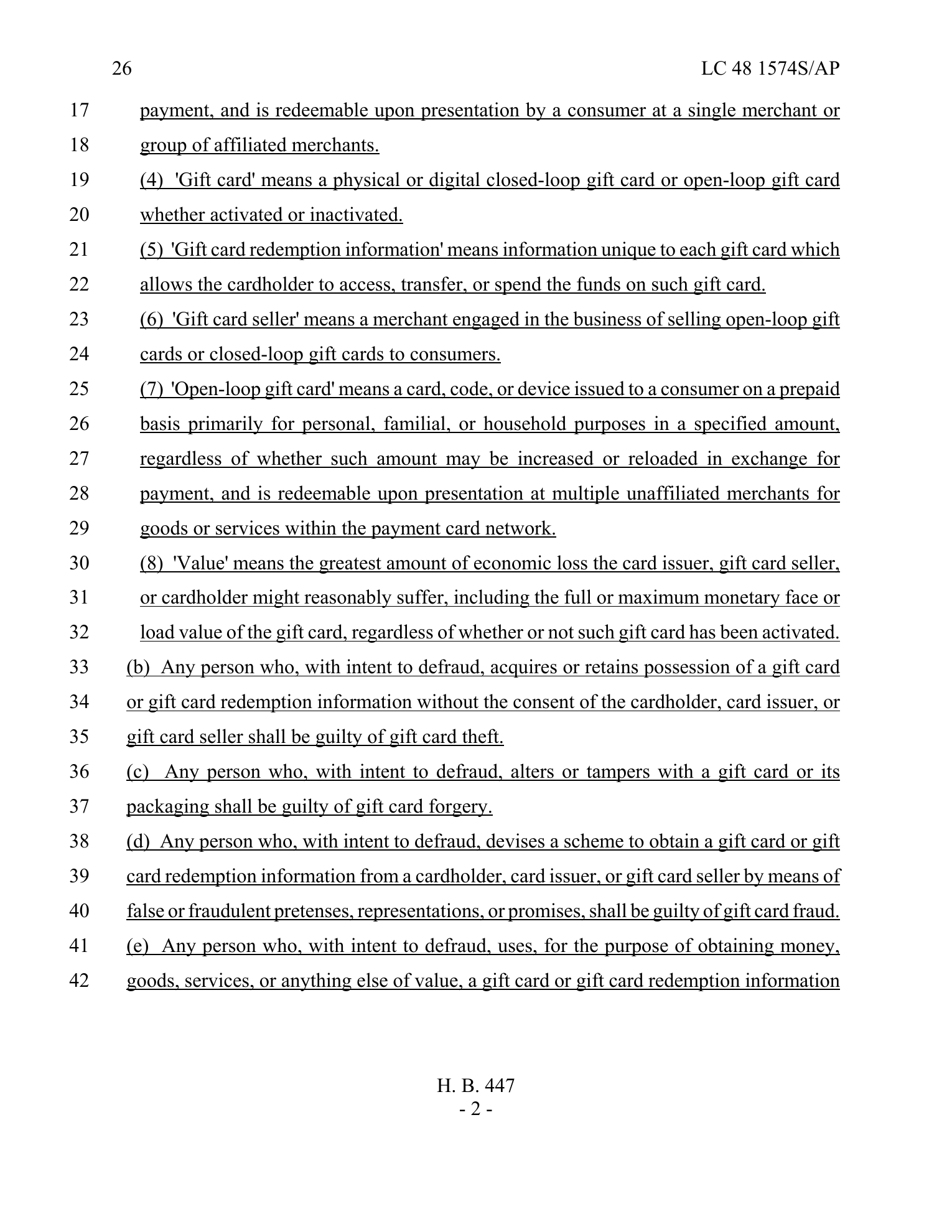
The law’s four main gift card offences
The phrase “with intent to defraud” matters. A damaged package, a failed code or a disputed transaction is not by itself proof of a felony. Evidence and intent still have to be established under the applicable legal process.
Why Nigerian gift card sellers should pay attention
Georgia law governs conduct connected to Georgia; it does not rewrite Nigerian criminal law or regulate every cross-border resale. Nigerian sellers should treat it as a risk signal rather than a foreign rulebook.
The connection is practical. A digital code can move across borders in seconds, while the theft, card-rack tampering or social-engineering scam that produced it may have happened somewhere else. A downstream seller may receive only a screenshot and a balance claim, with no view of the original purchaser or packaging.
The Georgia Attorney General’s consumer guidance specifically warns about criminals recording card numbers from retail displays, returning the cards to the rack and waiting for a consumer to activate them. It advises buyers to use reputable authorised sellers, inspect the front and back of a card, prefer secure packaging and keep the receipt.
Those checks are useful in Nigeria even though the statute is not Nigerian law. They help a legitimate seller explain provenance, help a buyer identify packaging risk and reduce the chance that either party becomes the final link in someone else’s fraud chain.
Six checks to make before accepting a card
1. Confirm who owns the card
Ask whether the person selling the card bought it, received it as a genuine gift or obtained it through a documented promotion. If the named purchaser and the seller are different people, ask for a coherent explanation and evidence of consent. Do not assume possession of a screenshot proves ownership.
2. Preserve proof of purchase
A receipt, order email or activation slip can connect the card to a legitimate transaction. Keep the complete original privately. When sharing proof for an initial check, redact the full code, PIN, barcode and unrelated payment details so the verification process does not expose the value.
3. Inspect physical packaging before revealing the code
Look for a lifted seal, replaced sticker, damaged scratch panel, mismatched serial information or packaging that appears to have been opened and resealed. Do not buy or trade a physical card simply because it later shows a balance. Balance and lawful origin are different questions.
4. Reject stranger-conversion instructions
Stop if someone asks you to receive cards, convert them to cash or cryptocurrency, purchase goods, forward items or split proceeds across accounts. A promised commission does not establish consent or lawful source. Our earlier report on a U.S. gift card fraud indictment explains how stolen card value can enter wider conversion chains.
5. Verify through a defined transaction process
Use the issuer’s official website or the established checks of a trusted trading platform. Do not enter an unredeemed code into an unknown “balance checker,” sponsored result or lookalike support site. A third party that captures the code may spend it before the real owner can act.
6. Slow down when the price and story do not match
A discount is not proof of fraud, but an unusually low offer combined with secrecy, urgency or weak proof deserves more scrutiny. Compare the facts, not only the potential payout. For a broader process, see our nine checks for selling gift cards safely in Nigeria.
What HB 447 does not mean
- It does not apply automatically to every gift card transaction in Nigeria.
- It does not make ordinary, lawful gift card resale a crime.
- It does not create a new NGN rate, payout formula or trading fee.
- It does not prove that every opened package, low price or failed code involved fraud.
- It does not replace advice from Nigerian law enforcement, a qualified lawyer, the card issuer or a payment provider.
The new law is best understood as a clear statement of the conduct Georgia wants to punish: theft of card value, packaging tampering, deception used to obtain redemption information and use of value acquired through those acts.
What to do with a suspicious card
- Pause the transaction. Do not redeem, resell, split or convert the value while ownership is unclear.
- Protect the code. Do not post it publicly or send it to another person for an informal check.
- Preserve original evidence. Save messages, receipts, order records, activation slips, photos of packaging and timestamps.
- Contact the issuer through its official channel. Use a URL you independently confirm rather than a link provided by the seller.
- Notify the platform or payment provider. Report facts and documents without publicly accusing a person before the evidence is reviewed.
- Use the appropriate reporting route. The U.S. Federal Trade Commission advises scam victims to contact the gift card company quickly, ask whether funds can be recovered and report the incident. Nigerian users should also follow the reporting instructions of their bank, payment provider, platform or local authorities.
Frequently asked questions
Does Georgia HB 447 cover digital gift cards?
Yes. The signed text defines “gift card” to include physical or digital open-loop and closed-loop cards, whether activated or inactive.
Can a person be punished just because a card fails?
No conclusion should be drawn from failure alone. The offences in HB 447 require intent to defraud and specific covered conduct. A technical error, region mismatch or ordinary dispute is not automatically criminal fraud.
Does the law change gift card prices in Nigeria?
No direct price or exchange-rate change follows from the statute. Nigerian offers still depend on the card brand, country, denomination, format, proof, buyer demand and current market conditions.
What is the most useful lesson for a legitimate seller?
Be able to explain the card’s lawful source without exposing its redemption information too early. Ownership evidence, an intact package and a consistent transaction history matter more than a screenshot that only shows value.
Sources and editorial note
News context reviewed August 16, 2026. This article summarizes a U.S. state law and official consumer guidance for general information. It is not legal advice and does not claim that Georgia law governs Nigerian transactions.
- Georgia General Assembly: HB 447 history, votes and effective date
- Office of Governor Brian P. Kemp: signed HB 447 PDF
- Georgia Legislative Counsel: 2026 Summary of General Statutes PDF
- Georgia Attorney General Consumer Protection Division: gift card guidance
- Federal Trade Commission: avoiding and reporting gift card scams